
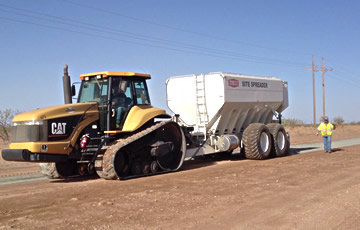
Base Stabilization: Building a Strong Foundation for Durable Pavements
Base stabilization strengthens an existing granular or reclaimed base layer so it can better carry traffic and protect the surface course above it. Instead of removing and replacing the base, crews treat it in place to increase stiffness, reduce moisture sensitivity, and create a uniform platform for paving. The approach fits both new construction and rehabilitation. On new projects it upgrades aggregate bases that are marginal or that will see heavier loads than originally planned. In rehabilitation work it addresses bases under cracked or rutted asphalt where distress is coming from below the surface rather than from the asphalt alone.
It helps to understand how base stabilization differs from related work. Subgrade stabilization improves the natural soil beneath the base. Full depth reclamation blends the asphalt and base together to rebuild the entire section as one layer. Base stabilization focuses on the base course itself, typically scarifying or pulverizing it to a controlled depth, treating it, then recombining and compacting it as an engineered layer. Treatment depths vary by design traffic and existing conditions, but the goal is consistent: a dense, well bonded base that resists rutting, moisture damage, and differential movement.
Owners choose stabilization when the base shows structural weakness that a simple mill and overlay will not correct. Indicators include wheel path rutting that returns soon after patching, widespread stripping or pumping under traffic, and evidence that moisture is weakening the base during wet seasons. The method is flexible across a range of facilities from parking lots and local roads to industrial yards, provided drainage and grades can be managed and utilities are accounted for. Because the work happens in place, it often reduces haul-off and import, which shortens schedules and lowers disruption for neighbors.
Materials and mechanisms are selected to suit the existing base and project goals. Cementitious binders such as Portland cement, lime, and fly ash form bonds that increase strength and lower plasticity. They are useful where fines and clay fractions dominate and where early strength is important for construction traffic. Asphalt binders, delivered as emulsion or foamed asphalt, create a flexible, moisture resistant matrix that performs well in bases with a healthy coarse fraction and reclaimed asphalt content. Combination treatments are common. A small dose of cement or lime can tighten early stability while asphalt emulsion or foam adds long term flexibility and moisture resistance. Mechanical improvement complements the chemistry. Adjusting gradation by blending in additional aggregate or fines can help the treated base compact to a dense, interlocked structure.
A disciplined project workflow drives results. Evaluation begins with test pits or cores to identify base thickness, gradation, fines content, and any contamination such as clay lumps or excess asphalt. Laboratory work follows to develop a mix design. After the base is pulverized or scarified in the lab to simulate field processing, technicians check gradation and moisture demand, then test candidate binder types and dosages. Strength and durability targets are set using familiar measures such as unconfined compressive strength or indirect tensile strength, along with moisture susceptibility checks. Proctor compaction data establish density and moisture ranges for field control. With a design in hand, field preparation addresses drainage issues, sets traffic control, and stages water and binder deliveries so production can proceed without interruption.
Construction is straightforward but requires attention to detail. The base is processed to the specified depth, shaped, and conditioned to the target moisture. The binder is applied at the designed rate and mixed thoroughly to achieve uniform distribution. Final grading establishes the cross slope and profile, then the layer is compacted to the specified density. A proof roll identifies soft or segregated areas that need correction. After a brief curing window, the stabilized base is ready for the surface course, whether chip seal, hot mix asphalt, or concrete.
Quality control keeps the work on target. Crews verify binder spread rates, monitor moisture and density during compaction, and check that the processed base meets gradation expectations. Samples of compacted material can be collected for laboratory confirmation of strength and moisture resistance. Many projects reference common ASTM and AASHTO procedures for index testing, density, and strength so that acceptance criteria are clear to everyone on the team. Documenting test locations, results, and any corrective actions helps to resolve questions quickly and supports a smooth closeout.
Weather and traffic management are part of planning. Production rates can be high when operations are coordinated, but success depends on staying within temperature and moisture limits that allow reactions to develop and density to be reached. Phasing maintains access for users while sections cure. Opening criteria are based on density and early strength so construction traffic can move onto the layer without damage.
Safety and environmental stewardship are built into the process. Cementitious binders and asphalt products require appropriate personal protective equipment, careful handling, and dust and runoff control. Integrating the work with the project stormwater plan helps contain treated spoils and protect nearby waterways. Because stabilization recycles in place, it typically reduces truck trips and the environmental footprint associated with importing new aggregate.
Cost and risk compare favorably with remove and replace when large areas are affected. Unit costs are driven by treatment depth, binder type and dosage, production rates, and mobilization. Common pitfalls are well known. Ignoring drainage leads to recurring moisture problems. Poor moisture control makes density hard to achieve. Inadequate mixing leaves pockets that do not gain strength. Skipping laboratory design invites overdosing or underdosing and inconsistent performance. Addressing these items early protects the budget and the schedule.
The result of effective base stabilization is a uniform, durable foundation that supports the surface course and extends pavement life. With careful evaluation, a sound mix design, and disciplined field control, owners and project teams can turn a marginal base into a reliable platform ready for years of service.